Basement Renovations
Home Theatre Design and Installation in Toronto and the GTA
A good home theatre is mostly about what you cannot see: the walls, the wiring and how quiet the room is.
Get a fixed-price quote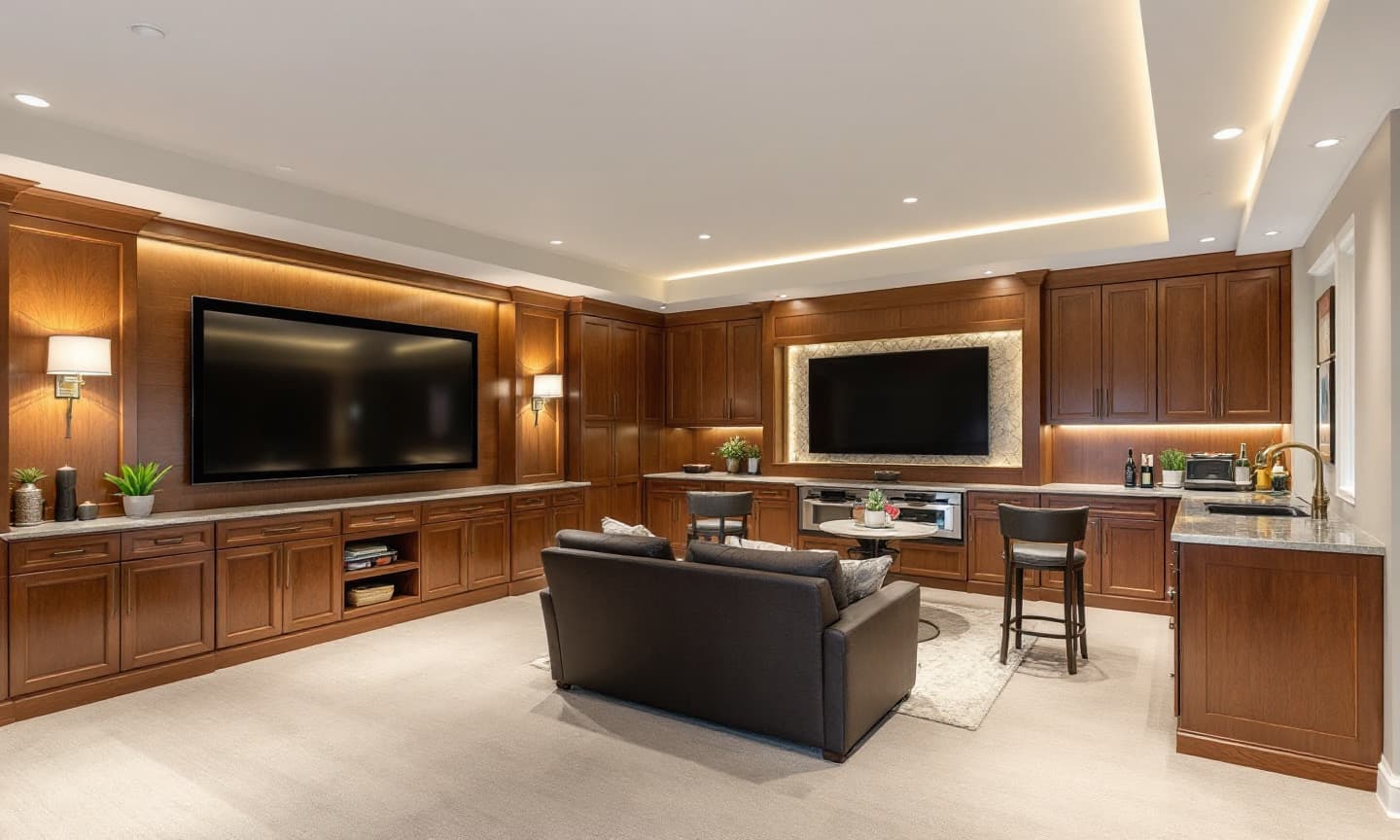
Buying a big screen and good speakers is the easy part. What makes a room feel like a theatre is sound that stays in the room, a picture you can see without glare, seating at the right distance, and equipment that is hidden but easy to service. Almost all of that has to be decided before the drywall goes up.
We design the room around the screen size and seating you want, then plan the construction to suit: insulated and isolated walls and ceiling, dedicated circuits, conduit for cables, lighting on dimmers, and ventilation that does not hum. If you have an audio-video integrator you like, we work with them. If not, we coordinate one so the room and the equipment are planned together.
What is included
Home theatres by Lintel
Room design
Screen size, viewing distance and seating rows laid out in 3D, including riser height if you want one.
Sound isolation
Insulated walls and ceiling, with resilient channel or similar details where the room sits under living space.
Wiring and conduit
Speaker wire, HDMI and network runs, plus empty conduit so future equipment can be added without opening walls.
Lighting
Dimmable layered lighting, step lights and sconces placed so nothing reflects off the screen.
Equipment storage
A ventilated rack location, inside the room or nearby, with access for service.
Finishes
Dark, low-reflection surfaces, acoustic panels where needed and carpet or rugs to control echo.
Before you build
What to plan for
Plan for heat
Amplifiers and projectors generate heat, and theatre rooms are usually closed. We plan ventilation for the equipment and the room so it stays comfortable through a long movie.
Decide on projector or TV early
A projector needs a mounting point, a clear throw path and often a dedicated circuit in the ceiling. A large TV needs blocking in the wall. Both are easy to build in and awkward to add later.
FAQ
Home theatres: common questions
How do you soundproof a basement home theatre?
Full soundproofing is difficult, but you can reduce sound transfer a lot. We use insulation in the walls and ceiling, decouple the drywall from the framing where it matters, seal gaps around doors and openings, and use a solid-core door.
Do I need a dedicated room for a home theatre?
Not always. A media area in an open basement works well for most families. A closed room gives you better sound and light control if movies and sports are a big part of how you use the space.
Can you install the audio and video equipment?
We build the room and all the rough-in. For the equipment itself, we work with your audio-video specialist or coordinate one for you, so the wiring and the room are planned together.
More basement renovations
Where we build
Start here
Start your home theatres project
Tell us a little about your project. We will call within one business day to arrange a site visit, then show you a design in 3D and a fixed price before anything is built.
Prefer to read first? See how we work.